Water | Craft: Tali Weinberg
Weaving the World's Wounds: Tali Weinberg and the Language of Climate
While many artists address environmental issues with a sense of urgency, Tali Weinberg’s work asks us to slow down. She turns climate data into something tangible, something we can feel through familiar textures. Her contributions to Water | Craft arrive at a pivotal time for our region's broader conversation about ecological responsibility.
Weinberg's practice begins with data—specifically, the kind of data that tends to disappear into abstraction the moment it's rendered as a chart or map. Through her ongoing Climate Datascapes series, she translates information from sources like the National Oceanic and Atmospheric Administration (NOAA) into woven fiber works that make climate change legible in a physical manner. Her Silt Studies, 2021 do exactly this: three woven works corresponding data from the Upper Mississippi River Basin, the Lower Mississippi River Basin, and the Great Lakes River Basin—watersheds familiar to visitors at MMAM—each woven from plant-derived dyed fibers and fishing line into something that feels less like data visualization and more like a shimmering earth-toned landscape.
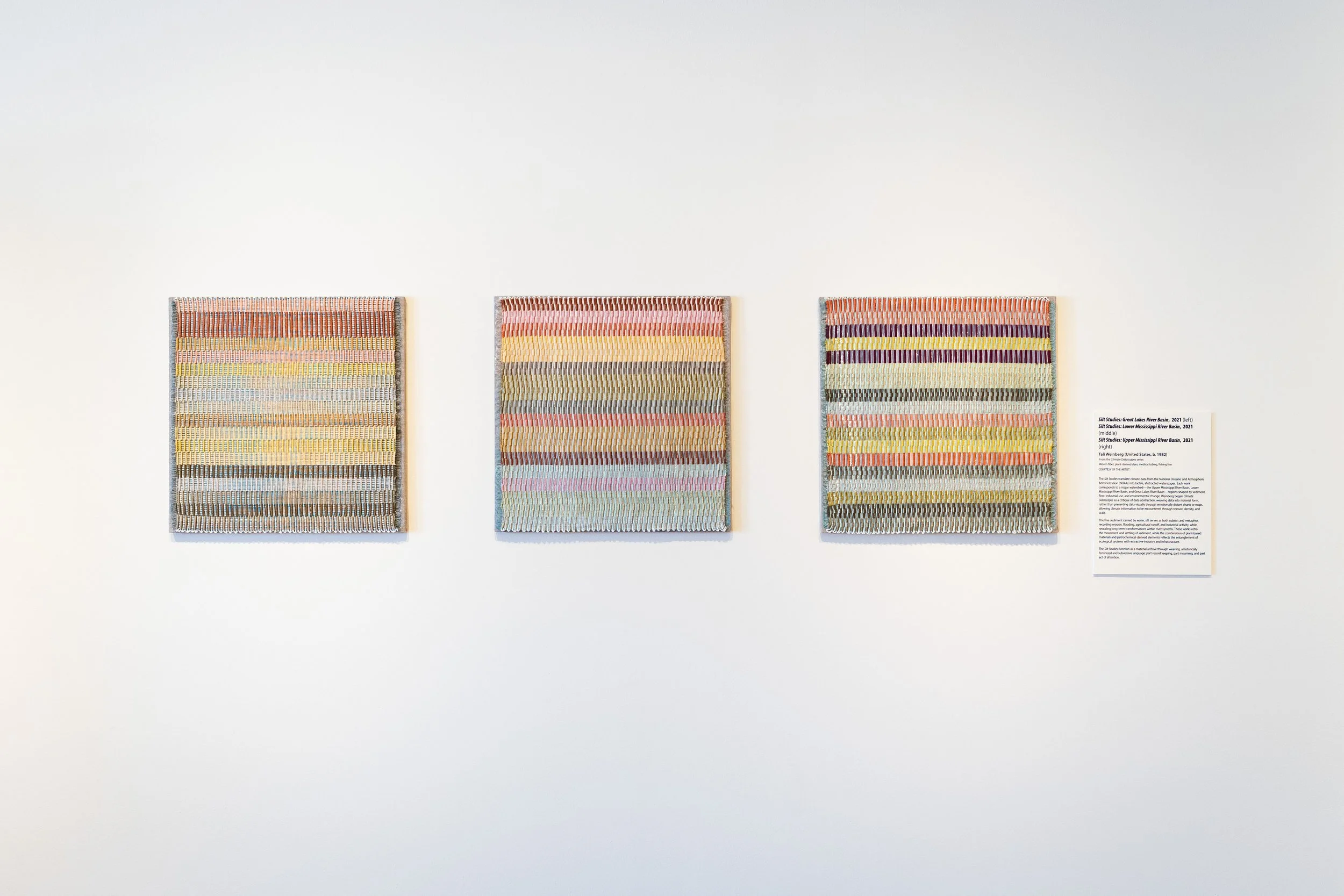
Installation photo by Bailey Bolton for the Minnesota Marine Art Museum.
Silt is an apt subject for this kind of attention. It records everything: erosion, agricultural runoff, industrial activity, the long, slow transformation of river systems under pressure from human use. Weinberg's weavings honor this archival quality, treating the loom as an instrument of record-keeping in the tradition of textiles that have always carried more information than their surfaces let on. Weaving has historically been feminized, domesticated, and underestimated—and that history is not incidental to her practice. It is, in many ways, the point.
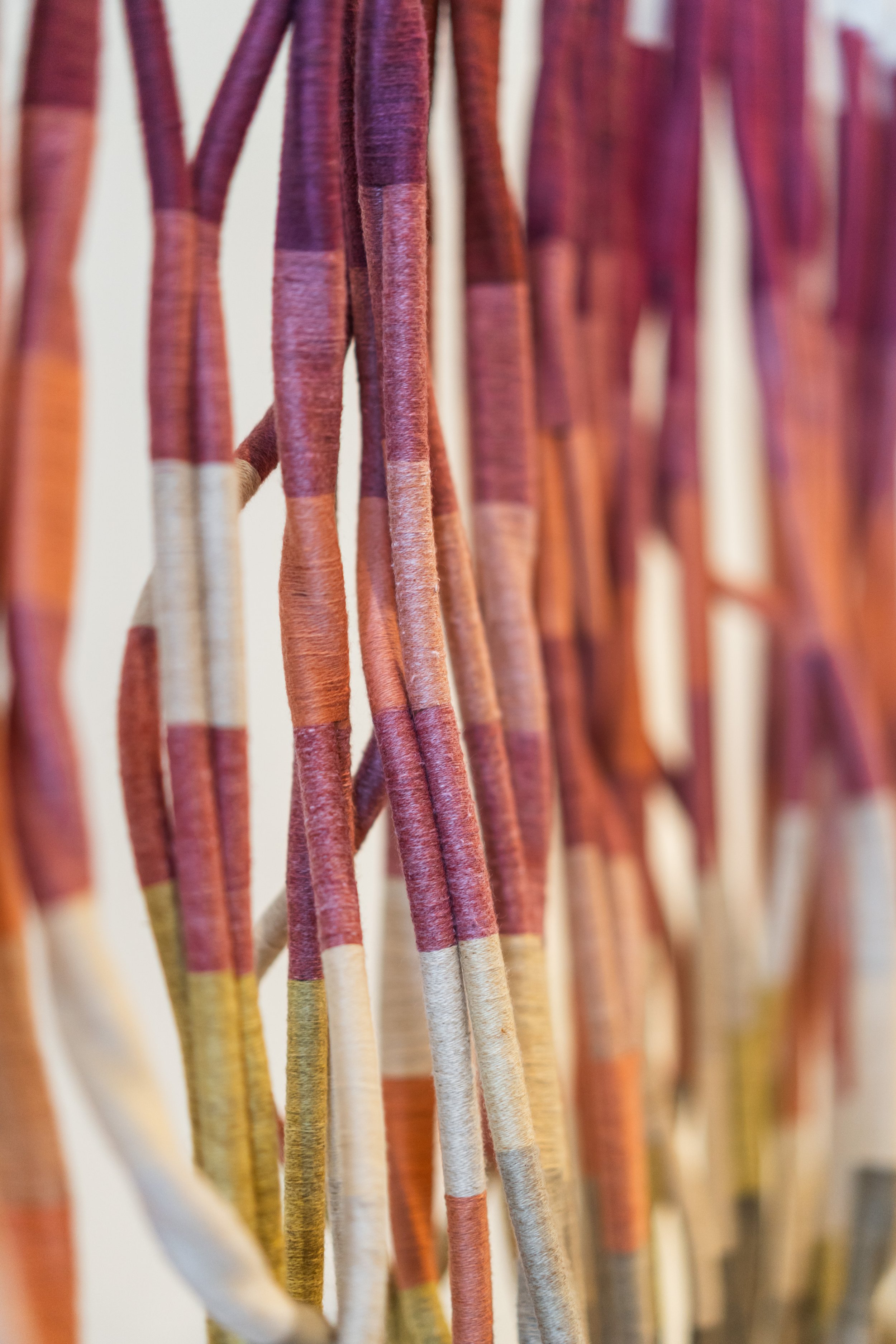
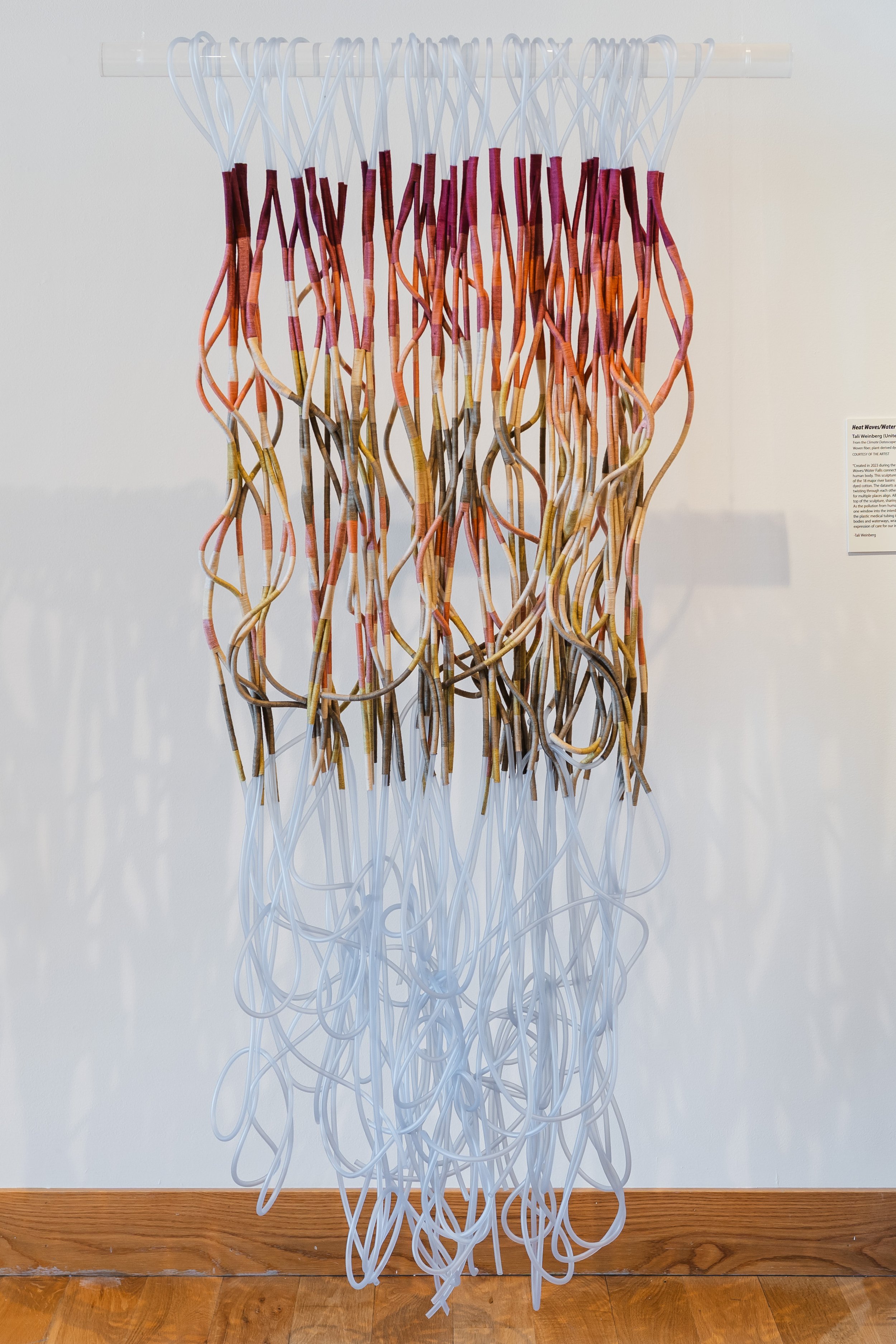
Heat Waves/Water Falls, 2023-24 extends this inquiry into the body itself. Created during the hottest months of what was then the hottest year on record, the sculpture encodes annual average temperature data for each of the 18 major river basins in the continental United States into coiled, plant- and insect-dyed cotton wrapped around bundles of plastic medical tubing. The watersheds converge, their temperature data twisting together—a material argument for the interconnectedness of ecological and human health that no chart could make with the same force.
Her most recent works on view, Short of Breath / Ash Borer Scars 8 and 9, 2025, trace something even more localized and devastating. The Emerald Ash Borer—an invasive beetle species introduced to the United States this century—has tunneled through Black Ash populations with consequences that extend far beyond forestry, disrupting the cultural practices of Indigenous communities for whom the tree is irreplaceable. Woven on a digital jacquard loom, these works map the larvae's hidden paths beneath bark, rendering visible a destruction that is easy to overlook. Strands of plastic fishing line shimmer across the surface, echoing the insect's metallic body while implicating the broader presence of synthetic material in environments we tend to imagine as purely natural. These works tie in beautifully to Kelly Church’s pieces nearby, both highlighting the devastating consequences of the loss of ash trees on the Indigenous practices of basketry in the upper midwest.
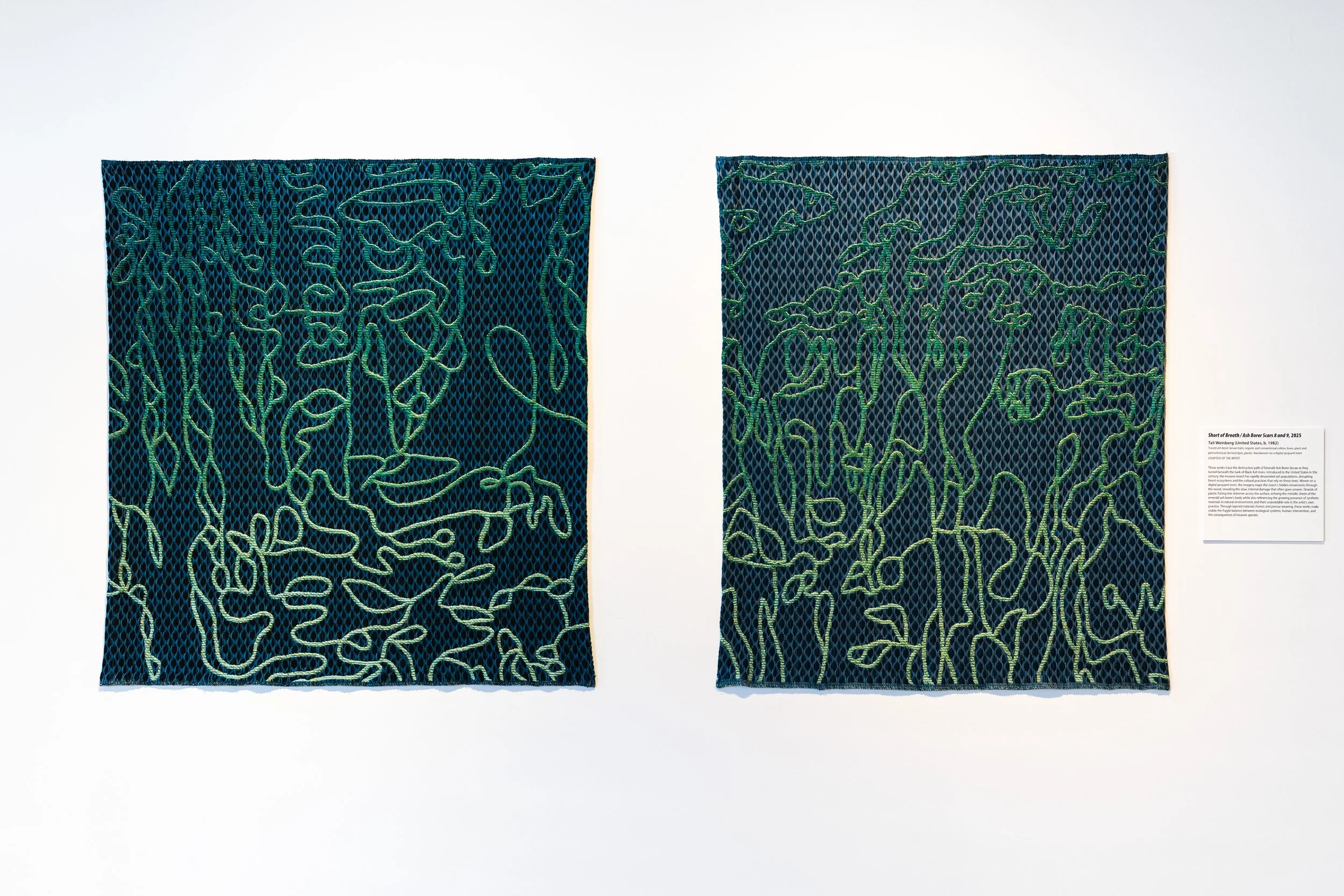
Across all of these works, Weinberg holds a tension that feels essential to Water | Craft as a whole: between scientific rigor and emotional honesty, between the systems-level view and the intimate, handmade gesture. Her materials—plant dyes, medical tubing, cotton, linen, fishing line—are chosen with the same care that she brings to her data sources, and the combination refuses easy comfort. These are not elegies. They are acts of attention.
We are thrilled that Weinberg will bring this ethos to Winona in a particularly meaningful way this spring. She will serve as keynote speaker for the upcoming Climate Change and Freshwater Sustainability Conference co-hosted by Winona State University and MMAM—a conversation we expect will resonate deeply with students, educators, and community members grappling with the environmental realities of our own river valley.
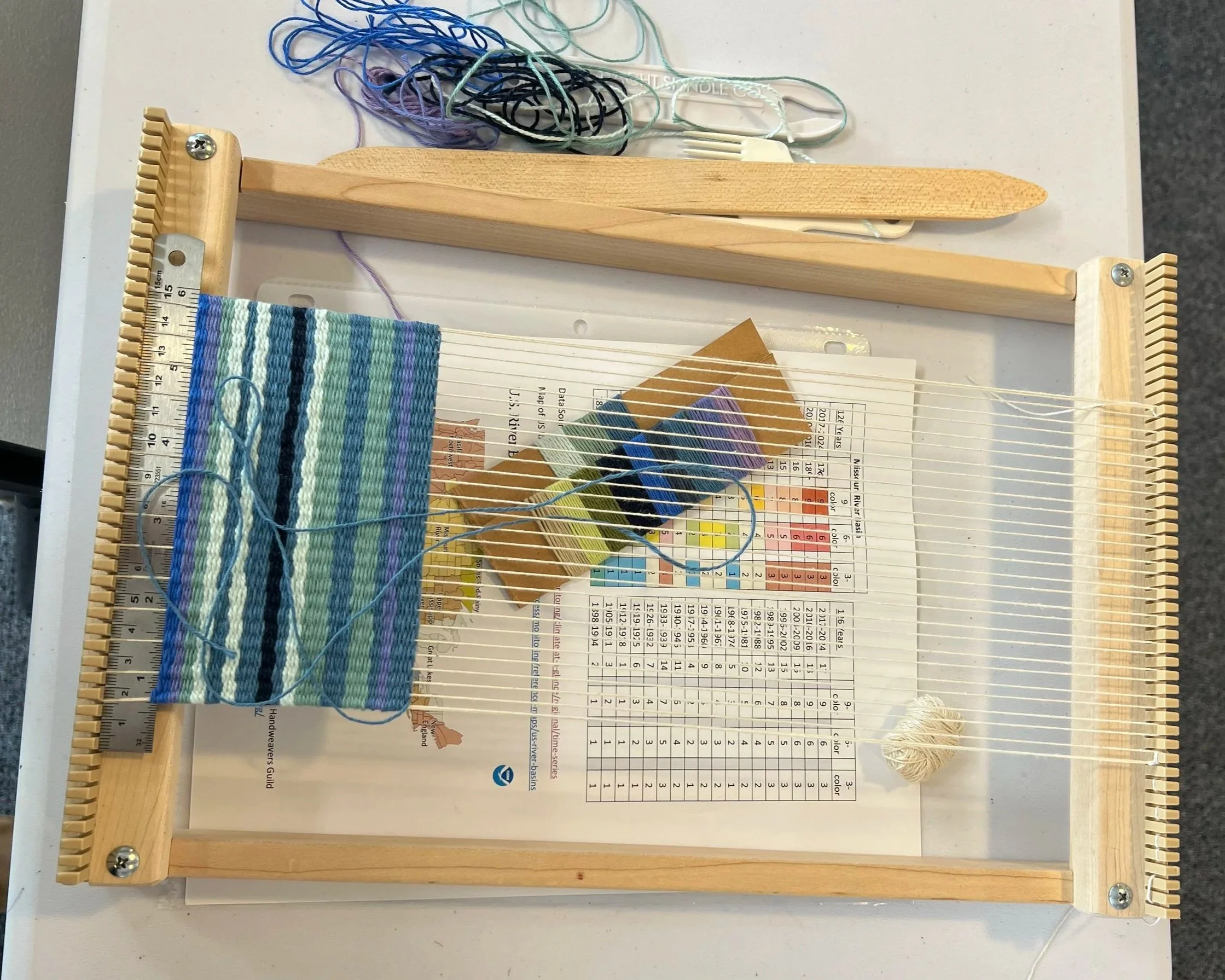
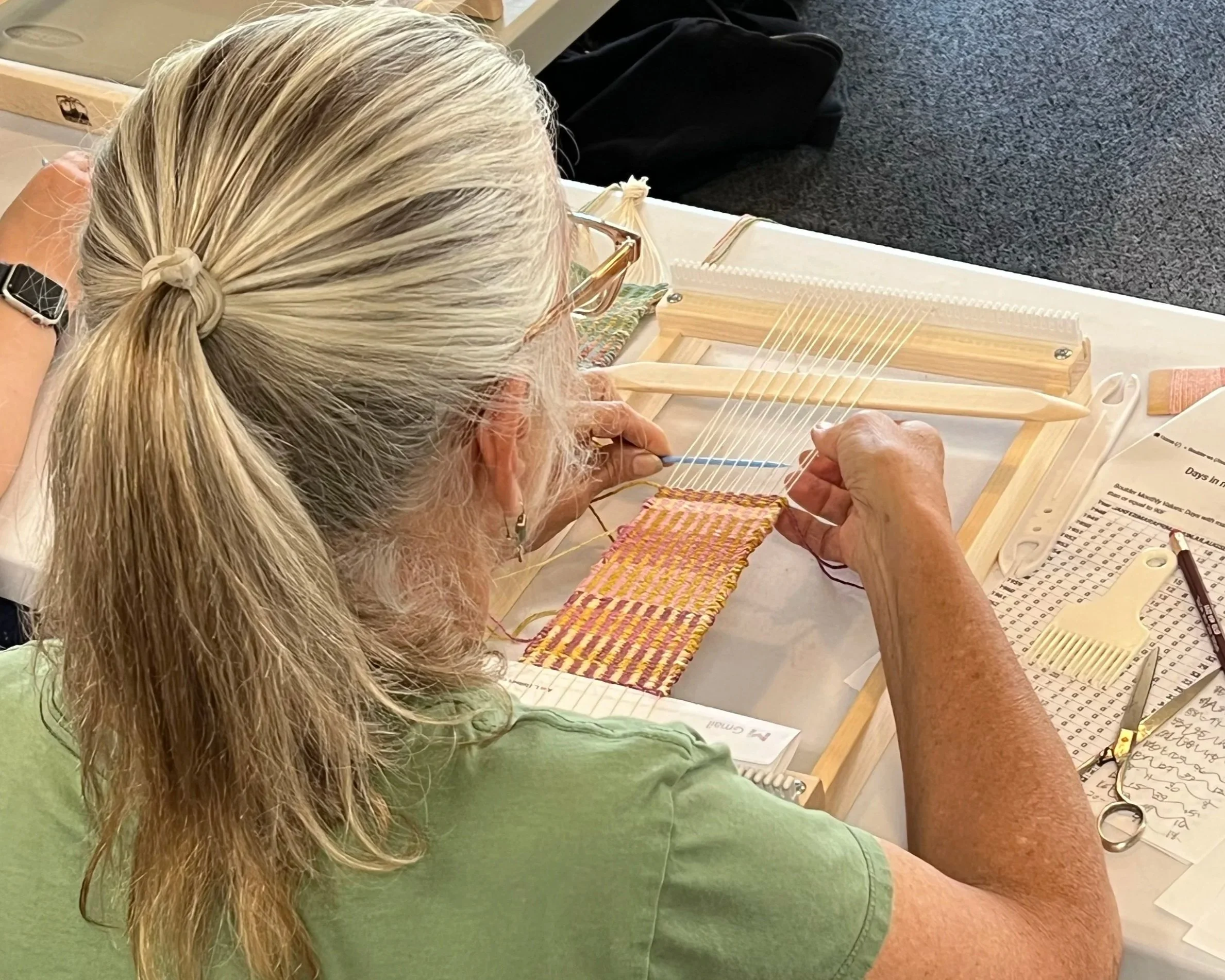
And for those who want to understand the artist’s practice for themselves, Weinberg will lead a special two-day workshop on Friday and Saturday, March 20–21, from 9:00 a.m. to 2:00 p.m. each day. Participants will begin by reflecting on landscapes and waterscapes that hold personal meaning, then learn to interpret climate data through color and pattern on small frame looms—combining discussion, observation, and hands-on making into woven studies that honor both scientific understanding and lived relationship to place. No prior experience with weaving or data is required, and all materials will be provided.
It is rare to encounter an artist whose practice so fully embodies the questions an exhibition is asking. Tali Weinberg's work insists that data has texture, that climate has memory, and that making something by hand is itself a form of reckoning. We hope you'll experience her work in the Water | Craft gallery, join us for the Sustainability Conference, and if you're able, spend two days at the loom with one of the most compelling voices working at the intersection of craft and ecological urgency today.
Water | Craft remains on view through December 27, 2026.